
Last updated September 20, 2026
Free on-site gate assessment - hinges, posts, and your LiftMaster or Nice gate operator checked before anything is quoted
The assessment is free and the quote is the invoice.


 Before
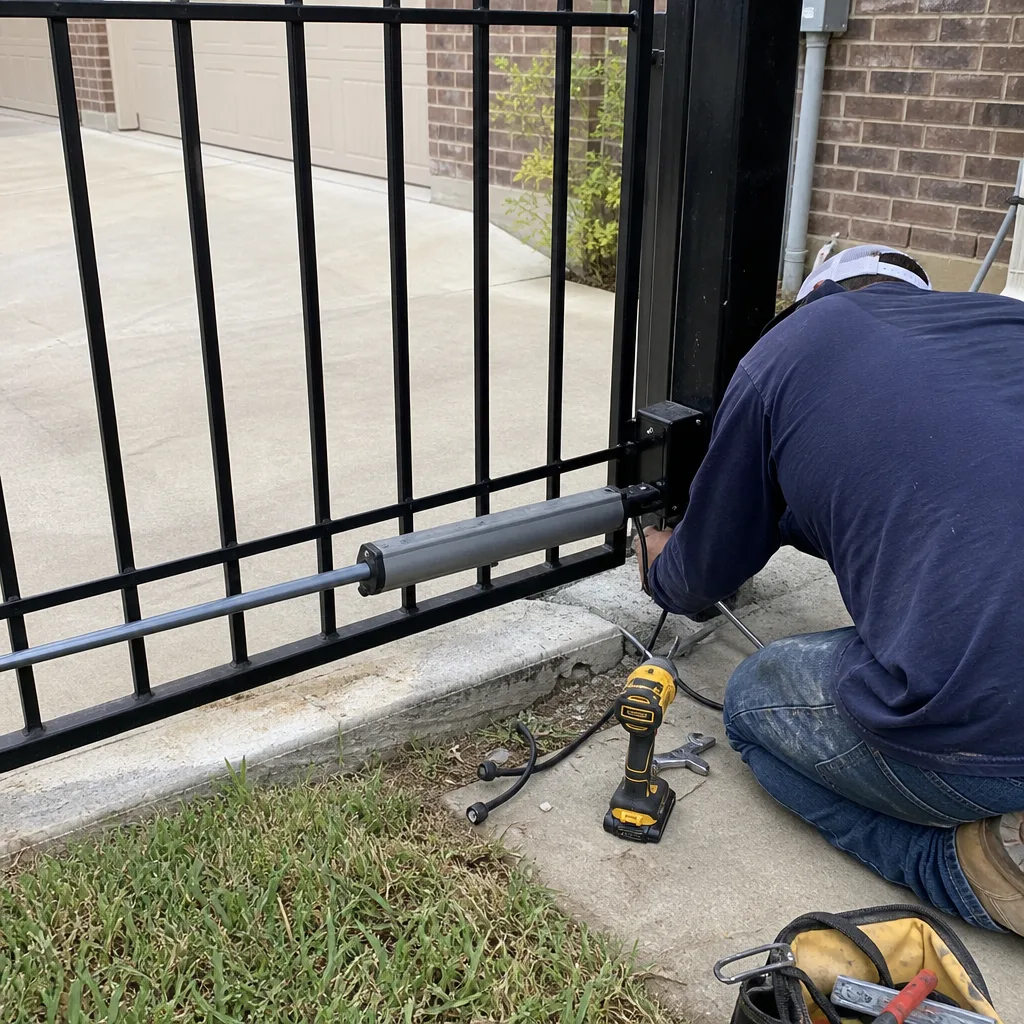 After
After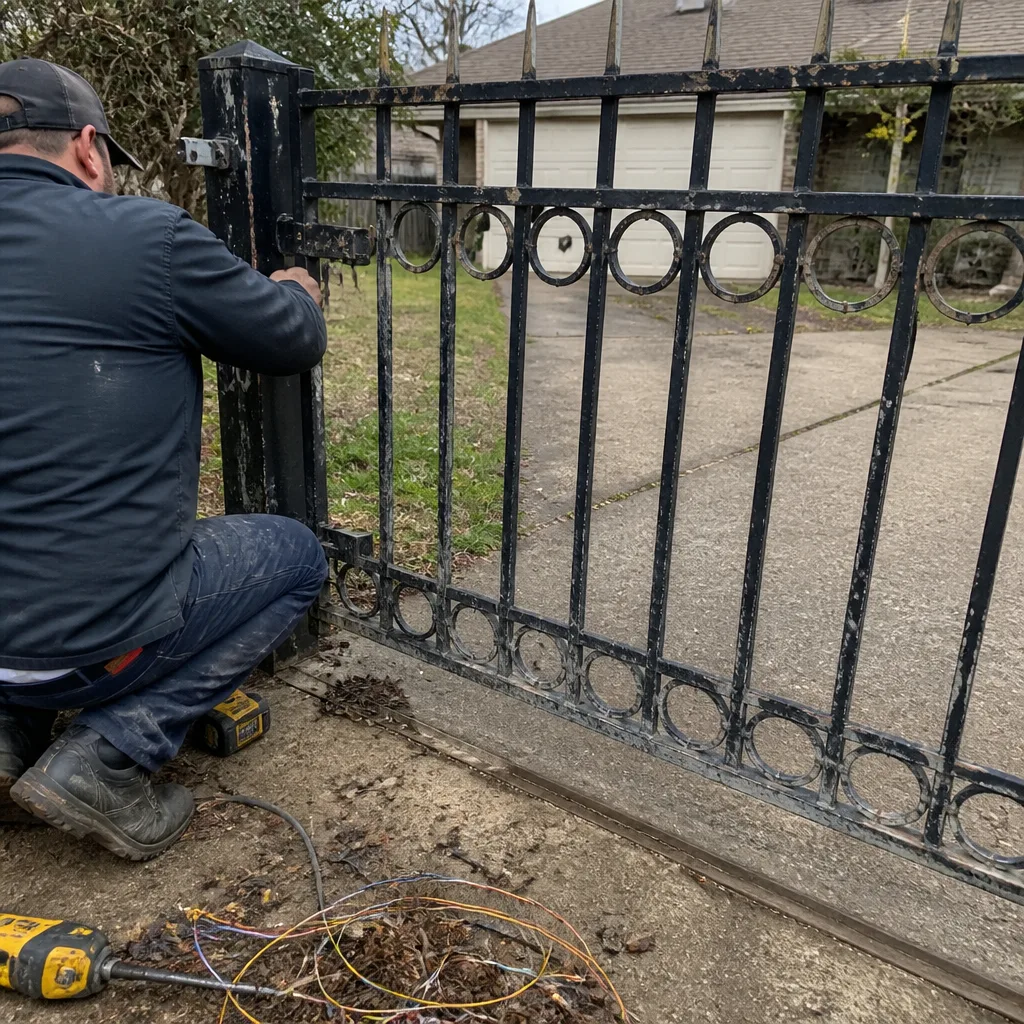 Before
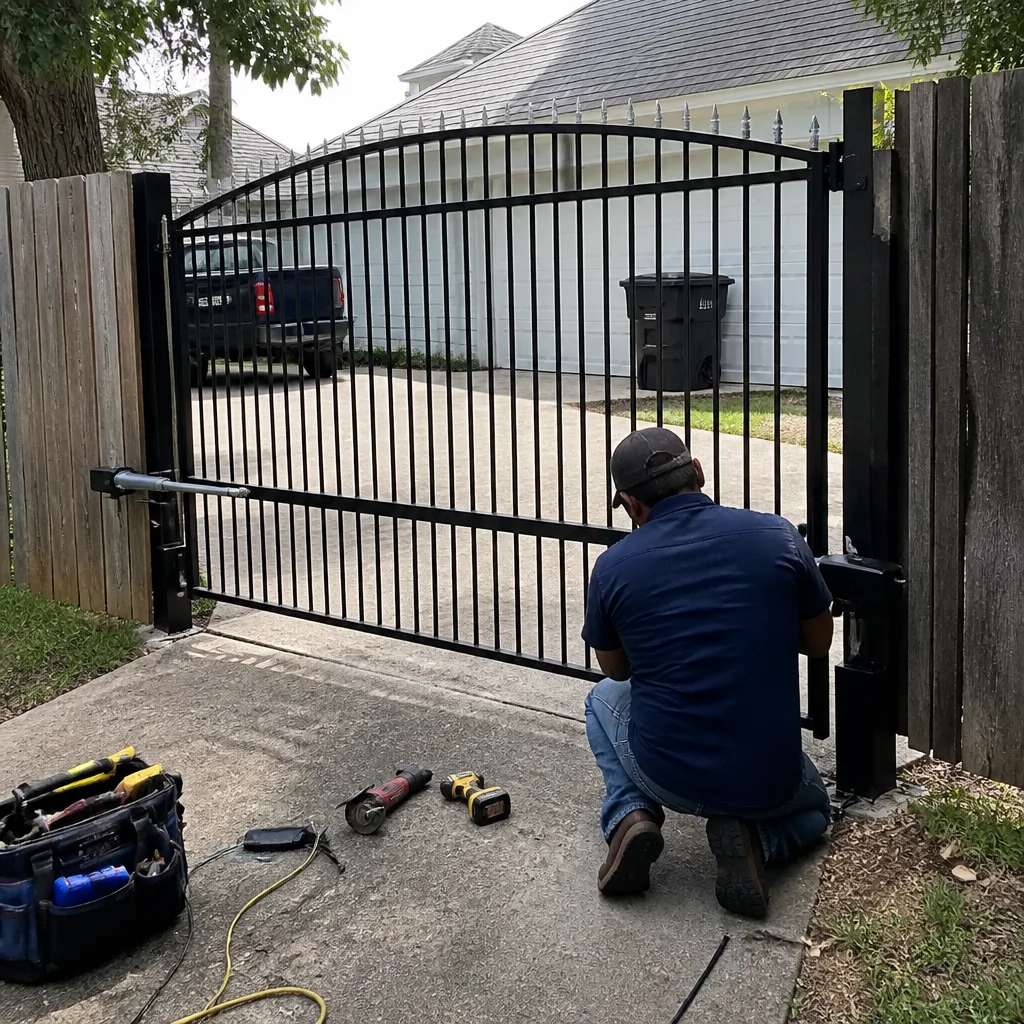 After
After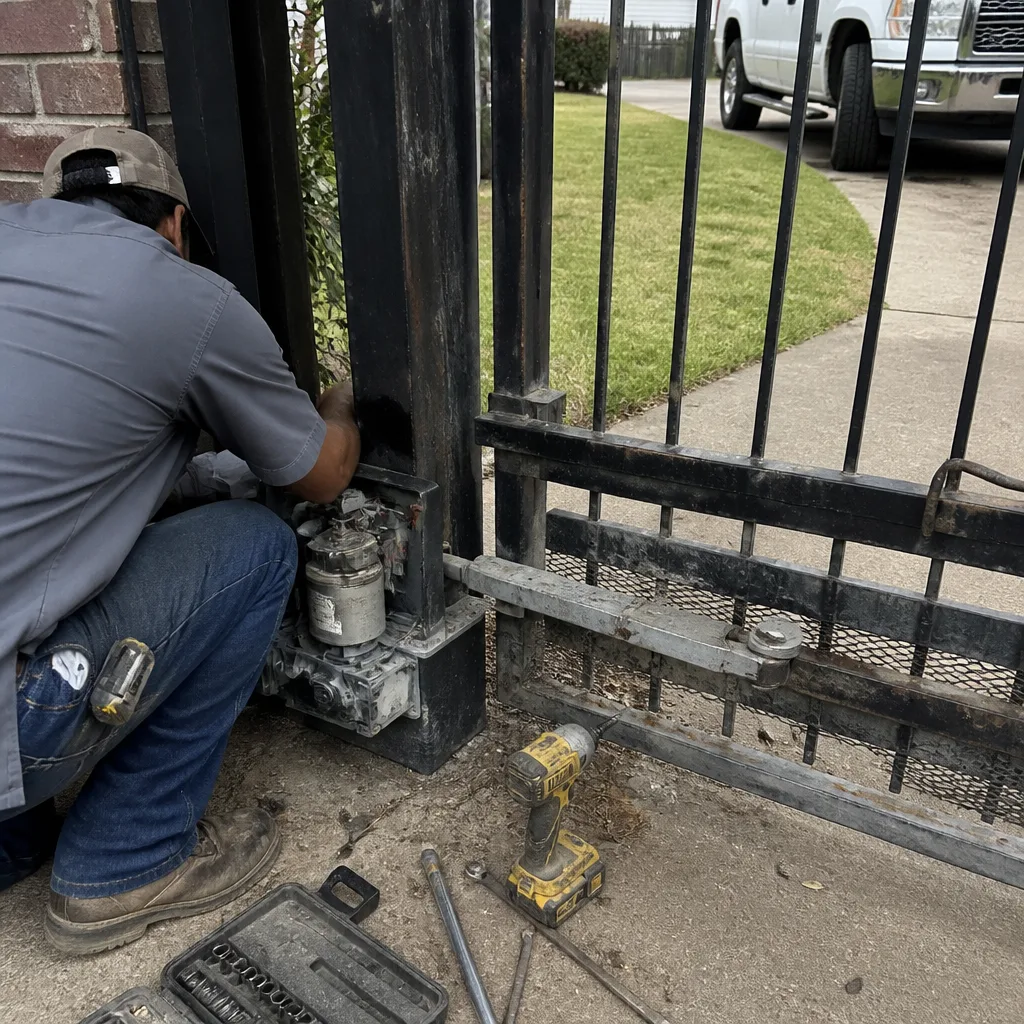 Before
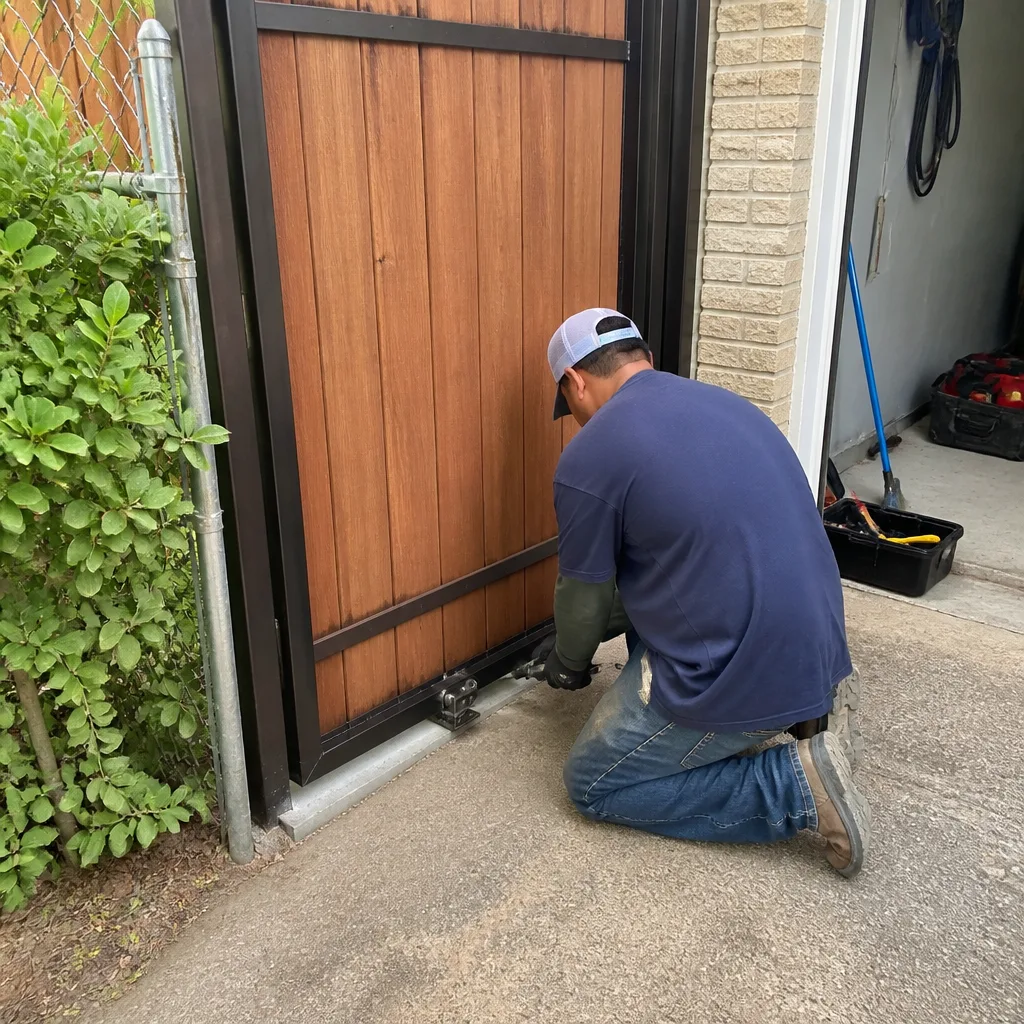 After
AfterDIY vs Professional Gate Repair: The Baytown Homeowner’s Decision Guide
The average driveway gate in Baytown cycles between 14,000 and 22,000 times per year. That’s a lot of mechanical stress on hinges, wheels, chains, and circuit boards, and it explains why most gate failures in the Houston Ship Channel corridor aren’t sudden catastrophes; they’re slow degradations that homeowners notice, ignore, then panic about at 6:40 a.m. on a Monday. This guide-along with our Gate Repair Maintenance Checklist for Baytown Homeowners-draws the line between what you can safely fix yourself and what you shouldn’t touch, based on 22,000 gates serviced since 2014. You’ll learn the exact component-by-component breakdown, how Texas liability law changes the calculus, and what to document either way.
Quick Answer
Homeowners in Baytown can safely handle lubrication, visual inspections, battery swaps on standalone backup units, and basic hinge tightening. You should call a professional for anything involving the operator’s electrical connections, limit switches, photo-eye alignment, gearboxes, or any repair where the gate weighs over 150 pounds and is off its track. The line isn’t about skill; it’s about liability, safety, and whether you can document the work well enough to preserve your insurance position.
Table of Contents
- The Component-by-Component Task List
- Texas Liability: What Happens When DIY Goes Wrong
- Why DIY Limit-Switch Adjustment Causes Repeat Service Calls
- When DIY Actually Saves Money
- Documentation: What to Write Down After Any DIY Work
- Common Mistakes to Avoid
- When to Call a Professional
- Frequently Asked Questions
BeforeAfterThe Component-by-Component Task List
Most DIY-versus-pro guides sort tasks by difficulty. That’s the wrong axis. A hinge replacement is easy but can require two people and a floor jack. Replacing a backup battery is a five-minute job but doing it wrong voids the warranty on a $1,800 control board. The better way to sort is by component, because each component has its own risk profile, its own failure mode, and its own insurance implications in Texas.
Safe for Homeowners: The Maintenance Zone
- Hinge lubrication – Use a white lithium grease or a dry PTFE spray. Baytown’s humidity plus salt air from Galveston Bay means standard WD-40 evaporates in weeks. Apply every 90 days during summer, every 60 days if you’re within two miles of the water.
- Track cleaning – Slide gates accumulate sand and debris in the V-track. A stiff brush and a shop vacuum are sufficient. Check for small rocks after heavy rain; Baytown’s drainage patterns push gravel into driveway approaches.
- Visual inspection of wheels and rollers – Look for flat spots, wobble, or cracks. Photograph anything suspicious. You’re not fixing the wheel; you’re building evidence for a technician.
- Battery replacement on standalone backup units – Many Baytown homes have separate battery-backup boxes mounted near the operator. If the battery is in its own enclosure and has clearly labeled terminals, you can swap it. If it’s inside the operator housing, leave it alone.
- Sensor cleaning – Photo-eye lenses collect dust and spider webs. A microfiber cloth and glass cleaner restore function in thirty seconds. Spider webs inside the lens housing are the single most common source of “my gate stops for no reason” calls in Baytown.
Professional Required: The No-Touch Zone
- Limit switches – These control where the gate stops. Misadjusted limits cause the motor to push past its mechanical travel, which strips gears and burns out transformers. A limit switch set 12 degrees past travel is a $95 adjustment if caught early, or a $680 motor replacement if ignored.
- Photo-eye alignment – When a photo-eye is misaligned by even two inches, the gate either won’t close or reverses mid-cycle. Alignment requires a multimeter to verify signal strength at the control board, not just a visual check.
- Electrical connections inside the operator – Any wire connected to a 120V source, any capacitor, any transformer. In Texas, if that connection wasn’t permitted to begin with, touching it yourself creates a liability chain you now own.
- Gearbox or drive-chain replacement – These are mechanical but safety-critical. A chain that snaps under tension can send a 40-pound gate panel into a car or a person.
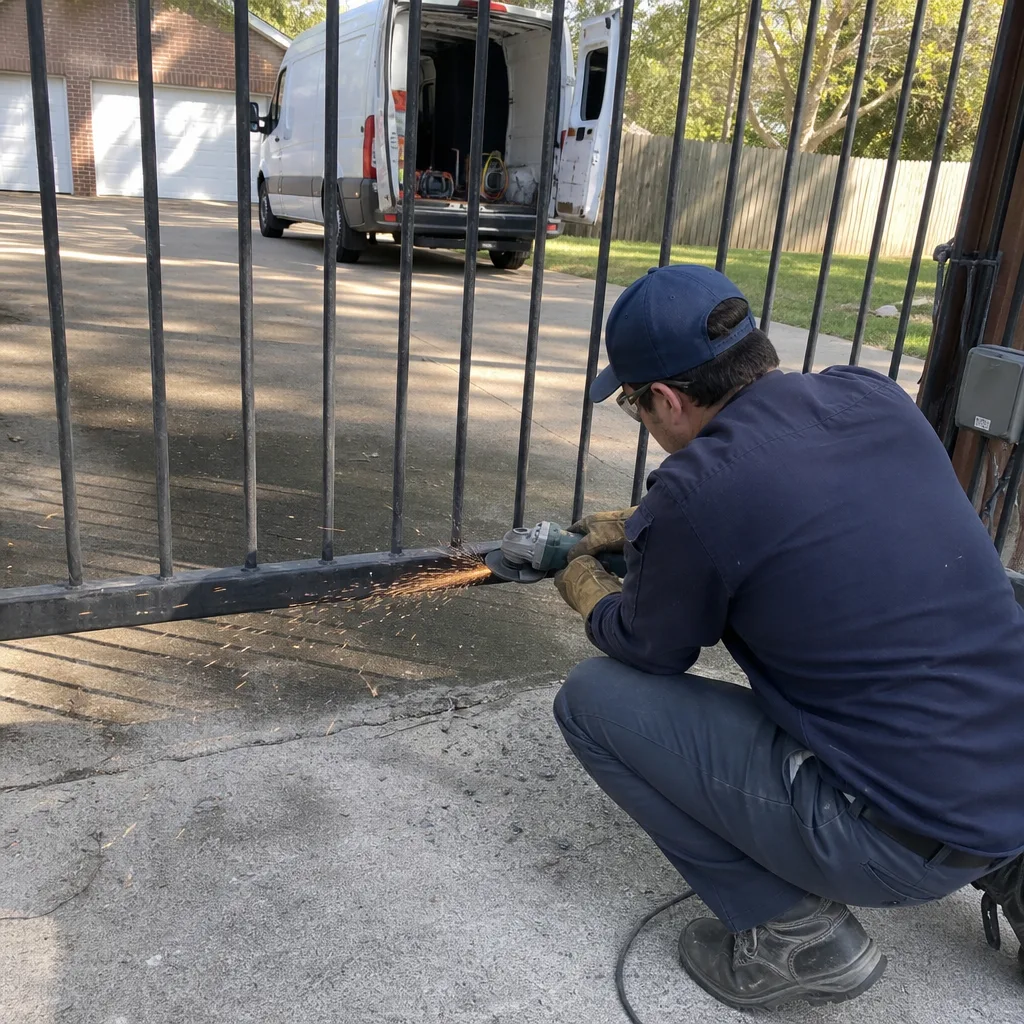
- Gate off its track – A cantilever gate that’s jumped its track weighs 300 to 800 pounds. Two people cannot safely re-seat it without a mechanical lift. Do not try.
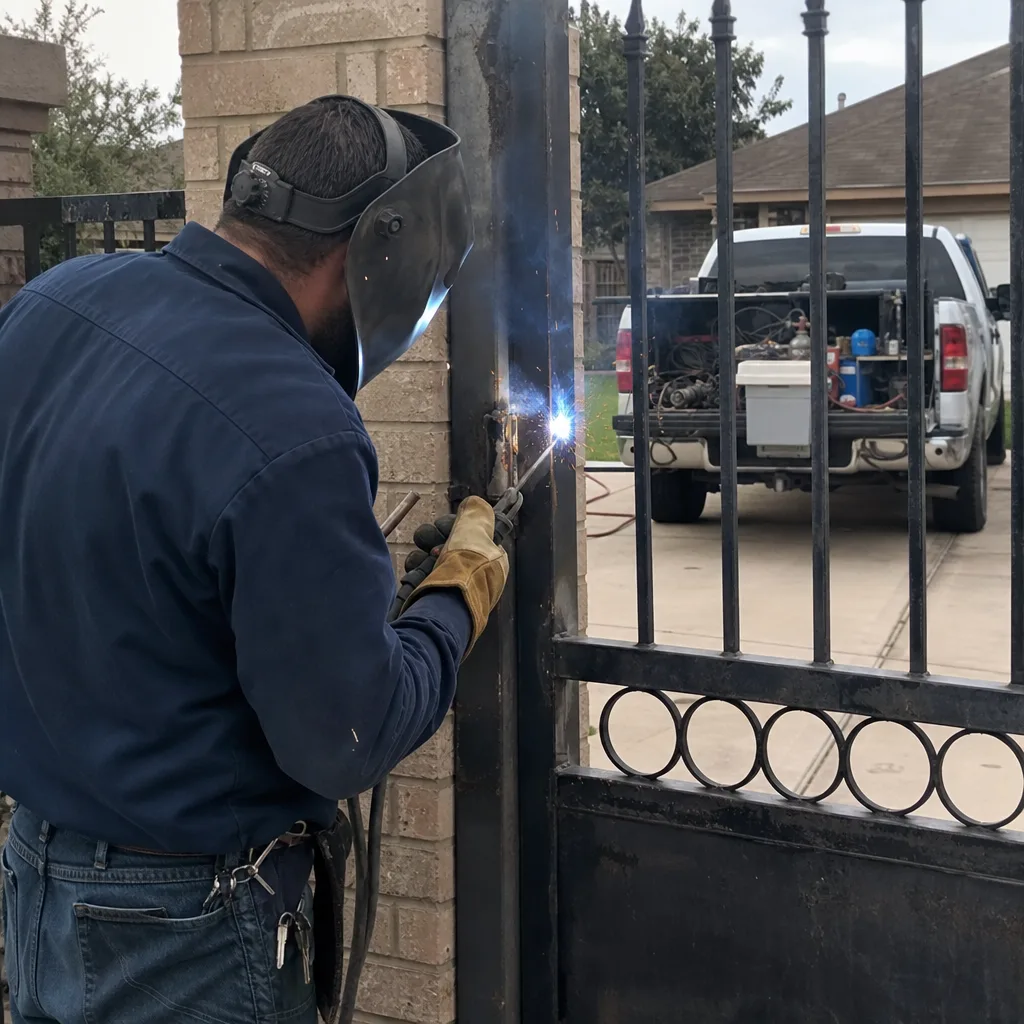
- Welding repairs – Cracked gate frames are common in Baytown due to soil movement from the clay-heavy ground. Welding requires a certified welder and often a permit depending on your location within Harris County.
Texas Liability: What Happens When DIY Goes Wrong
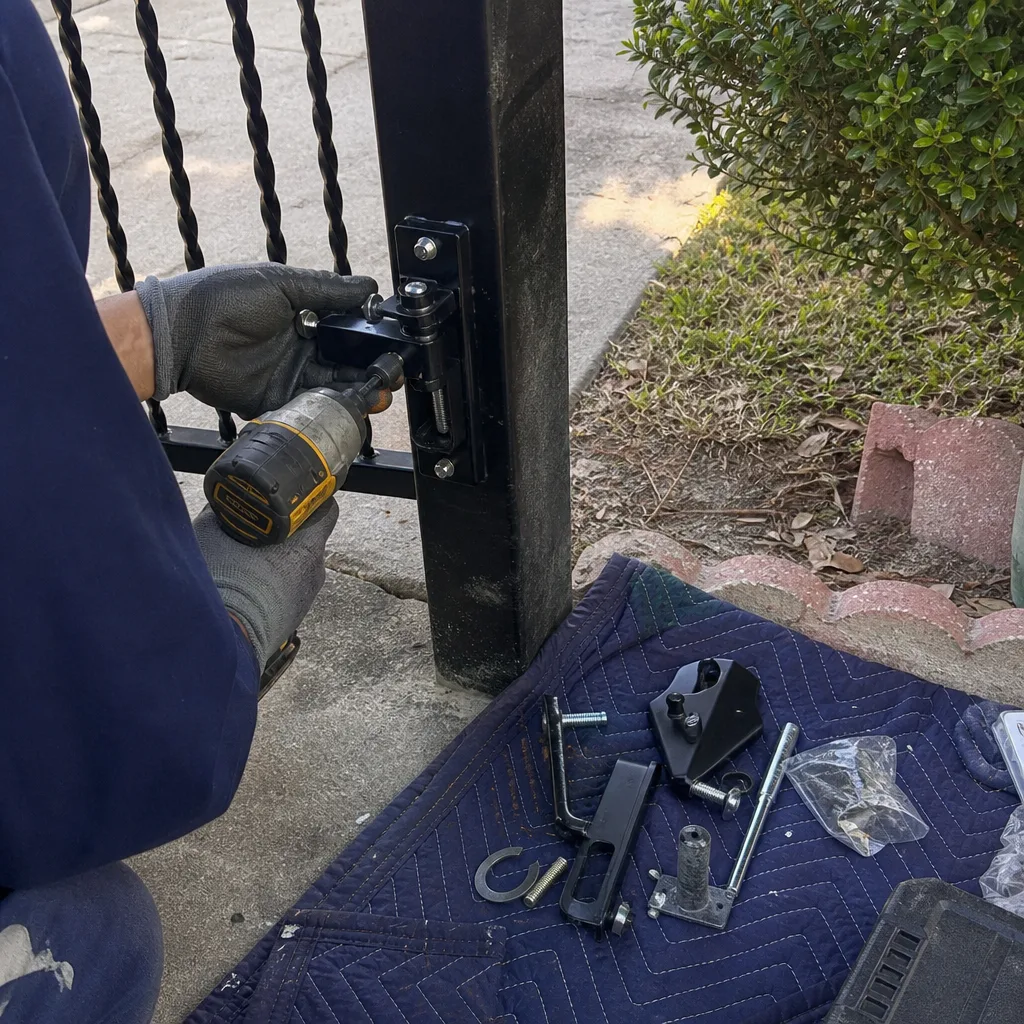
Here’s the part most gate-repair guides skip entirely, and it’s the part that matters most to Baytown homeowners. In Texas, homeowner’s insurance policies contain language about “reasonable maintenance” and “professional installation.” When you perform electrical work on a gate operator that later causes property damage, insurance adjusters have a documented record of asking one question: Who last touched the wires?
If the answer is you, the claim can be denied. Not always, but often enough that Baytown homeowners should treat any electrical gate work as a liability decision, not a skill decision. The Home Service Contract Act and various Texas Residential Construction Commission rules create implied warranties for work performed by licensed contractors. That warranty is an asset; when you hand the work to a properly licensed and insured professional, you’re also transferring the liability for that repair’s outcome, including the wiring diagram, the torque settings, and the code compliance. You can’t transfer liability to yourself.
There’s a second layer specific to Baytown and Harris County. Unpermitted electrical work is common in older neighborhoods around Baytown’s original grid. Homes built before the 2008 code updates often have gate operators wired directly into exterior panels without a GFCI or a dedicated circuit. If you open that operator and make a repair, and the house later has an electrical fire, the investigation traces back through every wire touched. Your insurance company’s subrogation team will look at the gate. If they find recent homeowner work, they’ll use it.
The professional standard exists for a reason. Gate Repair in Baytown from Vance Gate Repair includes a written scope of work and photo documentation specifically because those records answer the insurance company’s question before they ask it. The written record says a licensed technician performed the work, set the limits to the manufacturer’s spec, and left the site with the panel closed and the cover secure.
Why DIY Limit-Switch Adjustment Causes Repeat Service Calls
Limit switches are the most deceptive component on a gate operator. They look simple: two small dials or two plastic cams inside the operator housing. Adjust them a quarter turn, and the gate stops where you want it. What could go wrong?
Plenty, and we’ve seen the results across Baytown more times than we can count. When a homeowner adjusts a limit switch without checking the manufacturer’s spec sheet, three predictable failures occur. First, the gate overtravels and the rack gear or chain binds against the physical stop, which strips the drive gear over the next several hundred cycles. Second, the limit switch is set too tight, causing the operator to reverse before the gate fully closes, which leaves a gap that defeats the entire security purpose of the gate. Third, and most commonly, the homeowner watches a YouTube video for a LiftMaster FAAC BFT operator, but they have a Linear unit, and the adjustment procedure is entirely different, so their “fix” damages the cam mechanism.
Here’s what a technician actually finds when they arrive at a post-DIY limit-switch job in Baytown:
- The gate stops two to four inches short of the close position, or overtravels by the same distance.
- The operator’s LED diagnostic light is flashing a fault code the homeowner didn’t know how to read.
- The force-sensitivity setting has been cranked up because the gate was “struggling,” which means the gate will now push through an obstruction rather than reverse.
- The limit switch cam itself is cracked or the retaining screw is stripped from over-tightening.
The takeaway: limit-switch adjustment looks like a $0.50 adjustment on a $2 part. The actual cost of a misadjusted limit switch in Baytown runs $95 to $180 for a professional correction, or $400 to $900 if the gearbox or motor needs replacement after weeks of overtravel. The safe move is to leave the cover on.
When DIY Actually Saves Money
This isn’t an argument against all DIY. Some tasks are genuinely appropriate for a Baytown homeowner, and doing them saves real money over the life of the gate.
Lubrication Schedule
Professional lubrication service costs $75 to $150 per visit in Baytown. Doing it yourself costs about $12 for a can of white lithium grease that lasts a year. The schedule matters more than the product. Baytown’s climate is a corrosion accelerator: high humidity, salt-laced air near the bay, and summer temperatures that bake lubricant into a paste. Every 90 days is the minimum for hinges and wheels. Every 60 days if you’re east of Garth Road and within sight of the water. Write the date on a piece of painter’s tape under the operator cover so you remember.
Visual Inspections
Once a month, walk the gate’s full travel path and look for the following. Each item takes five minutes total and catches failures before they become $500 repairs:
- Wheel flat spots or cracks
- Track debris or obstructions
- Rust on weld points
- Loose hinge bolts
- Frayed or corroded wires at the operator whip
- Spider webs on photo-eye lenses
Battery Replacement on Standalone Backup Units
Many Baytown homes have a separate battery box, usually a gray or beige plastic enclosure within arm’s reach of the operator. If you can open the enclosure without entering the operator itself, replacing the battery is safe. Use a sealed lead-acid battery that matches the marked voltage, typically 12V 7Ah. Your total cost is $35 to $60, versus $150 to $250 for a technician visit. If the battery is inside the operator housing, that’s a professional job, full stop.
Photo-Eye Lens Cleaning
Already mentioned in the task list, but worth noting the math: a dirty lens causes a “gate reverses” or “gate won’t close” fault 40% of the time in Baytown service records. A clean lens fixes it for free. Keep a microfiber cloth in the garage next to the grease. Humidity and pollen in Baytown coat lenses in three to four weeks between April and October.
Documentation: What to Write Down After Any DIY Work
The single best thing a Baytown homeowner can do, DIY or not, is build a paper trail. When a gate fails and you call a technician, the technician is walking in blind. They’ll spend the first 20 minutes diagnosing what the previous state was, even if there was no previous professional work. A homeowner who can say “I lubricated the hinges with white lithium on June 12th” saves the technician time, which saves money.
Here’s the minimum documentation for any DIY gate maintenance:
- Date of the work – even a simple “8/14, garage gate, lubed hinges” in a notes app qualifies.
- Product used – brand and type. “WD-40” tells a different story than “3M white lithium.”
- Photo before and after – a phone photo of the component at the moment of service. Ten seconds of work, months of value later.
- Anything abnormal you saw and left alone – “right wheel looks flat” written today means the technician looks at the right wheel specifically when they arrive, instead of discovering it after the gearbox strips.
- Any change in the gate’s behavior since the work – “gate reverses at the halfway point since I cleaned the sensors” tells the technician the problem may be alignment, not dirt.
Without this record, the technician starts from zero. That’s how Vance Gate Repair Baytown home service calls get expensive, and it’s a fixable problem for anyone who spends ninety seconds after each DIY task.
Common Mistakes to Avoid
- Spraying WD-40 on everything. WD-40 is a water displacer, not a lubricant. It strips existing grease and leaves a thin, short-lived film. On gate hinges, tracks, and wheels, it actually accelerates wear. Use white lithium grease or dry PTFE. Baytown’s humidity makes the wrong lubricant’s failure visible faster than in dryer parts of Texas.
- Adjusting the force-sensitivity dial to “fix” a gate that reverses. The gate reverses because the photo-eye is blocked or the rollers are binding. Cranking up force turns the gate into a 400-pound moving wall that won’t stop when it hits something. That’s an injury risk and an insurance risk.
- Replacing a battery inside the operator housing without discharging the capacitor. Gate operator capacitors store 120V even with power off. Touch the wrong terminal and you’ll find out the hard way. This is the reason the professional line exists.
- Re-seating a gate that’s jumped the track using a car jack alone. A cantilever gate weighs 300 to 800 pounds. A car jack is designed for vertical lift, not lateral shifting. The gate shifts, the jack tips, and you’re under it. Every year, Baytown emergency rooms treat gate-related crush injuries that started with a car jack and a “quick fix.”
- Ignoring the flashing light on the operator. Every major brand, LiftMaster and FAAC BFT and Linear included, uses diagnostic flashes to indicate fault codes. The flashing light isn’t a generic “check engine” warning; it’s a specific error number that tells a technician exactly what failed. Don’t unplug the unit to reset the light and then ignore the problem.
- Painting over rust without addressing the corrosion. Baytown’s salty air means surface rust on gate frames is constant. Painting over it without grinding creates a rust sandwich that eats the frame from underneath. The paint looks fine for a year and then the post snaps at the base.
When to Call a Professional
Call a professional when the problem involves any of the following: electrical connections inside the operator housing, limit switches, photo-eye alignment, gearbox or chain replacement, gate-off-track, welding, or any repair where the gate weighs more than 150 pounds. Also call when the gate is your primary security barrier and you can’t afford a 48-hour window of uncertainty. Vance Gate Repair Baytown offers Gate Repair services with free estimates in Baytown, and a live person answers our phone 24/7. We service all major gate-automation brands, so we diagnose the unit you have, not the unit we wish you’d buy. Call (346) 315-4812 for a free estimate.
Frequently Asked Questions
Gate repair in Baytown typically runs $95 to $180 for adjustment work, $250 to $450 for component replacement, and $600 to $1,200 for full motor or control-board replacement, depending on the brand and whether the operator is residential or commercial-grade. For a detailed look at what drives these numbers, see our Gate Repair Cost Breakdown: The Baytown Homeowner’s Reference for 2026. Every Vance Gate Repair Baytown quote is written and handed to you before works starts, so the price you see is the price you pay, no surprise invoice after the repair.
You can handle maintenance tasks like lubrication, sensor cleaning, and backup battery swaps without professional help. You should not open the operator housing and attempt electrical repairs, limit-switch adjustments, or capacitor discharge, because those tasks carry electrical and mechanical hazards, and a DIY mistake on a 120V connection can void your insurance and damage the operator. Homeowners who attempted DIY limit-switch adjustments account for a significant portion of repeat service calls in Baytown.
Vance Gate Repair Baytown services nine major gate-automation brands, including LiftMaster, FAAC, BFT, and Linear, plus five others. We’re not tied to any single manufacturer, so we diagnose and repair whatever operator is already on your property rather than steering you toward a brand-new replacement. Gate Motor & Opener in Baytown covers our motor-repair process in detail.
Most gate repairs in Baytown do not require a permit, but new gate installations and some electrical work tied to new operator circuits may require one depending on your location within Harris County. If your home is in an unincorporated area of Harris County rather than Baytown city limits, the rules differ. We verify code requirements on-site and include any necessary permit language in your written scope before work begins.
If the problem is visible and mechanical on the outside of the operator, lubrication, cleaning, and bolt tightening are DIY-appropriate. If the problem involves wires, limit settings, motor function, or a gate that’s off its track, call (346) 315-4812. A live person answers our phone 24/7 and will tell you honestly whether the job matches the DIY list or belongs on our schedule.
Ask for a written scope of work, a written price before the job starts, a photo record of what was found and what was changed, and the exact part numbers installed. We provide all of this on every visit under our 365-Day Done Right Promise: if the repair isn’t right, we make it right at no additional charge within one full year.
A well-maintained steel or aluminum gate in Baytown lasts 15 to 20 years before major structural repair, though coastal salt exposure east of Garth Road can shorten that to 10 to 12 years for powder-coated steel. The operator typically needs replacement or major service every 7 to 10 years. The Gate Installation in Baytown guide covers what materials hold up best in the local climate. Regular lubrication and monthly inspections extend the service life by several years.
The Bottom Line
DIY gate repair in Baytown isn’t a yes-or-no question. It’s a component-by-component decision where some tasks cost you $12 and save $150, while others cost you $0 to attempt and $900 to undo. Lubricate hinges, clean photo-eyes, swap standalone backup batteries, and write down what you did. Leave limit switches, electricals, gearboxes, track re-seating, and welding to a licensed professional with commercial-grade documentation habits. A gate is a security barrier and a moving 400 to 800 pound machine; both roles argue for a written record and a named technician. For more guides & resources, visit our blog. When in doubt, call us at (346) 315-4812 and ask. A live person answers, and we’ll tell you which side of the line your problem falls on.
Written by Adrian Vance, Owner at Vance Gate Repair Baytown, serving Baytown since 2014.