
Last updated September 20, 2026
Free on-site gate assessment - hinges, posts, and your LiftMaster or Nice gate operator checked before anything is quoted
The assessment is free and the quote is the invoice.

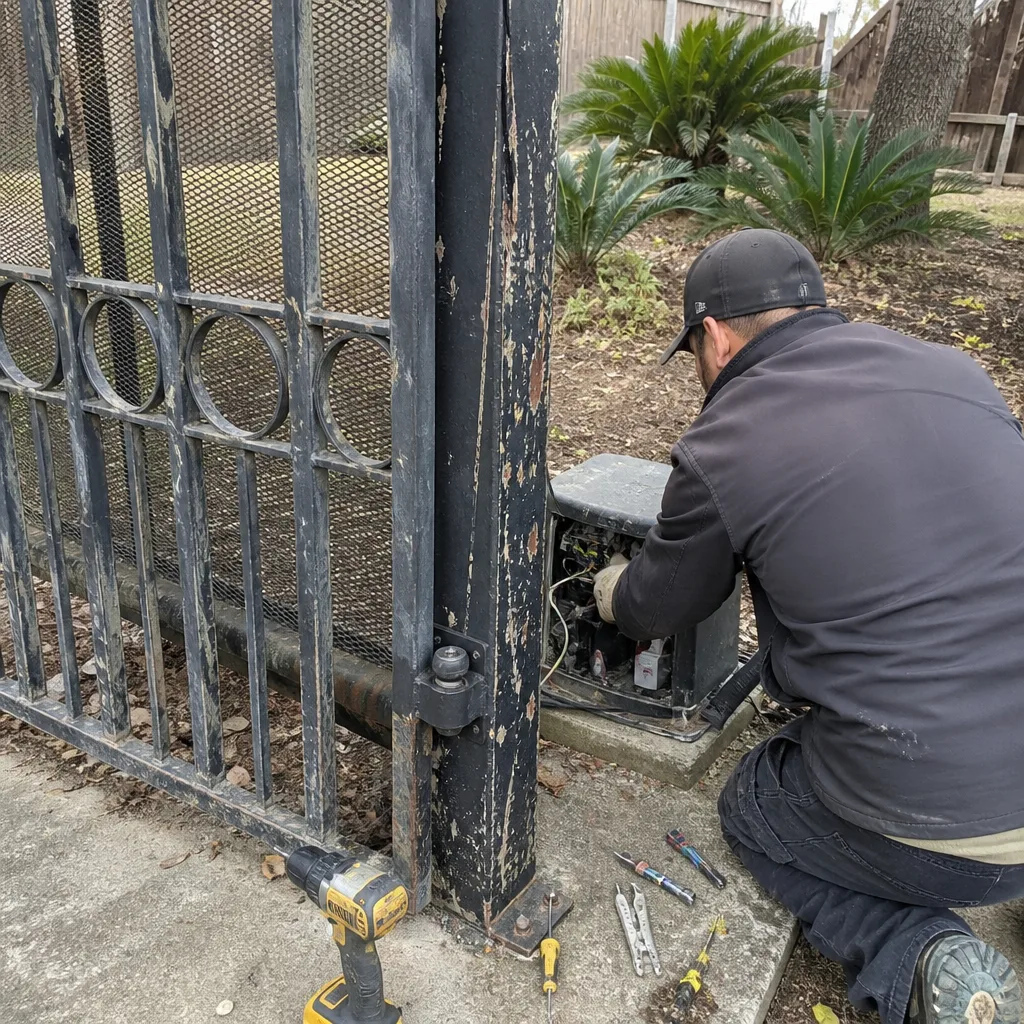 Before
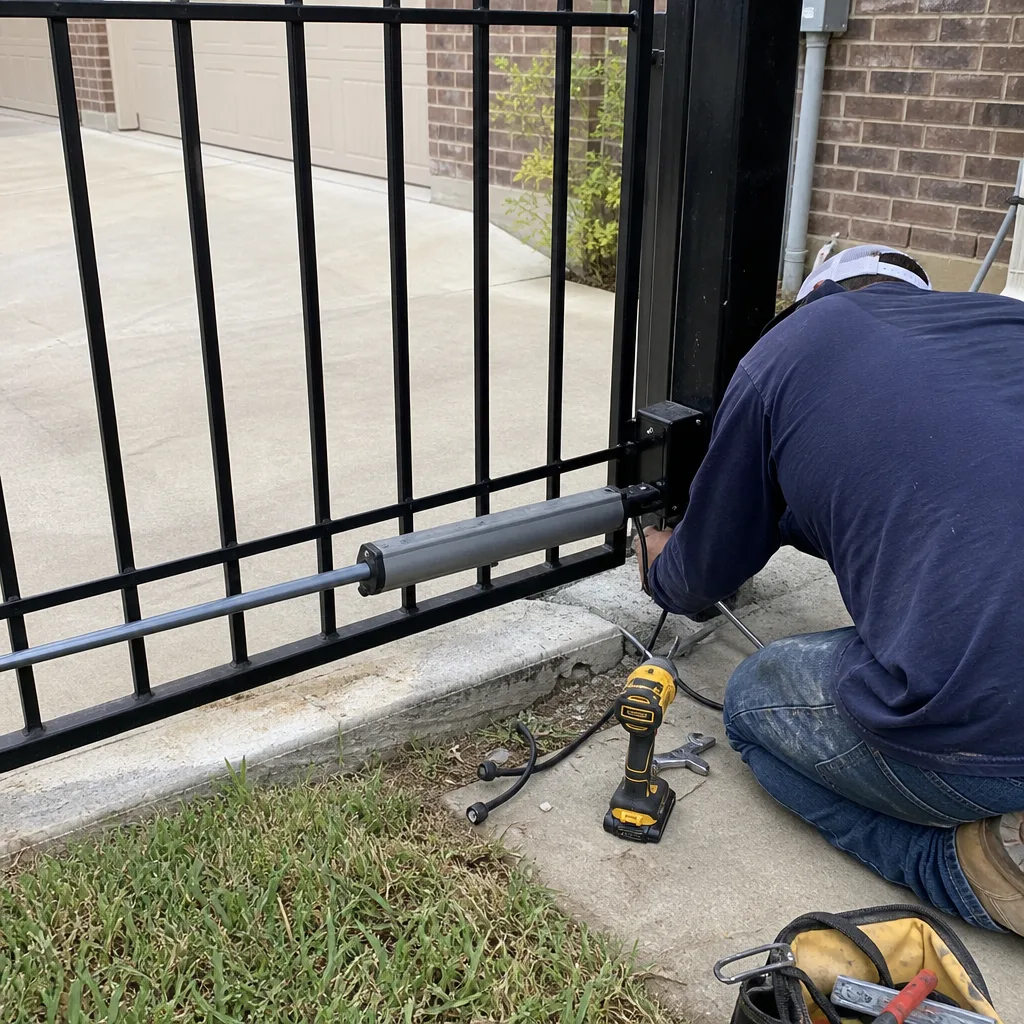 After
After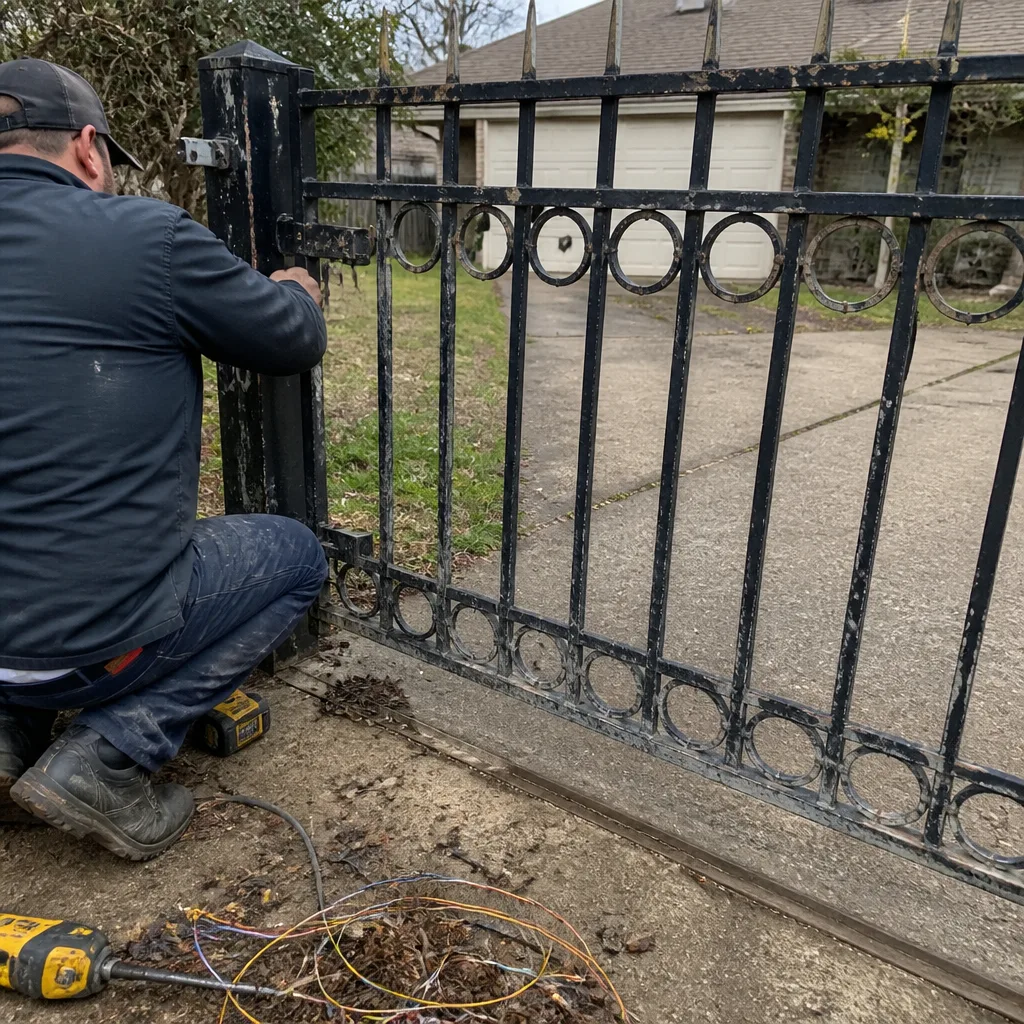 Before
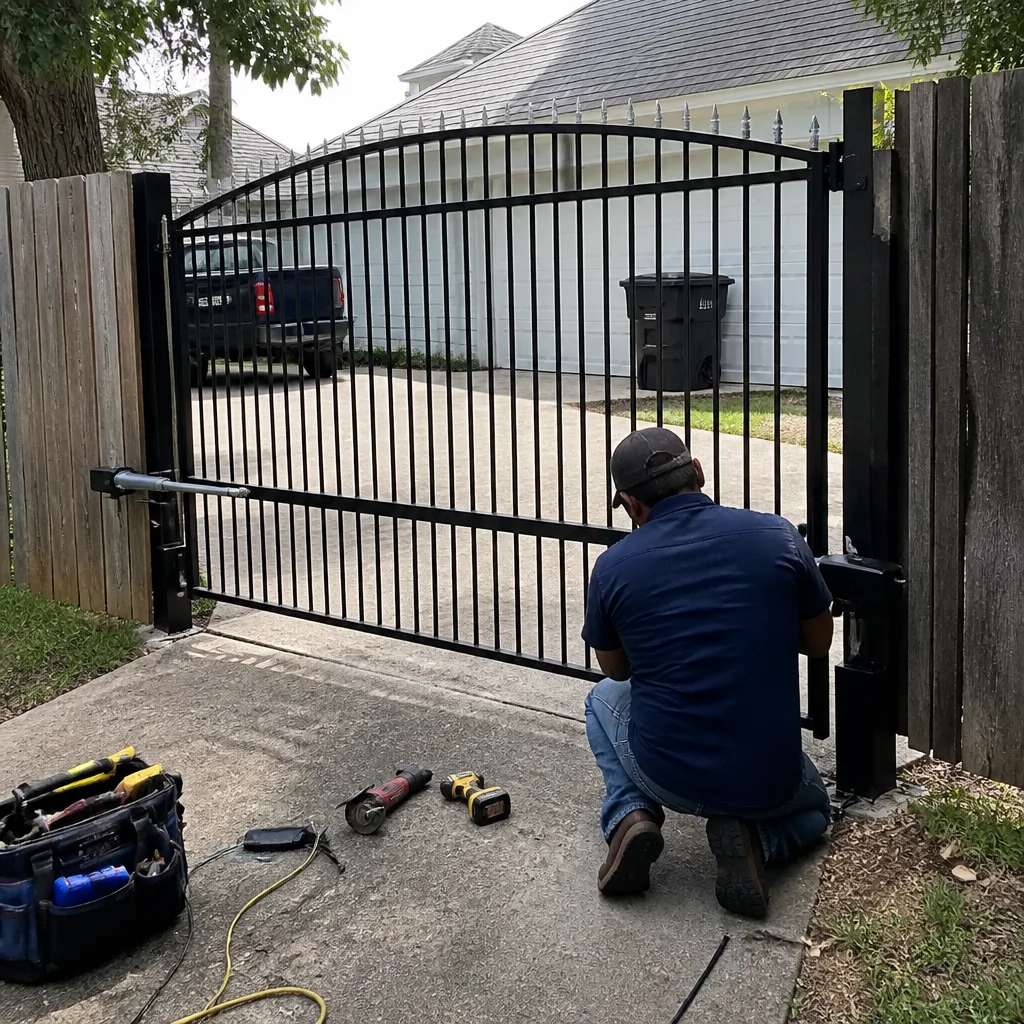 After
After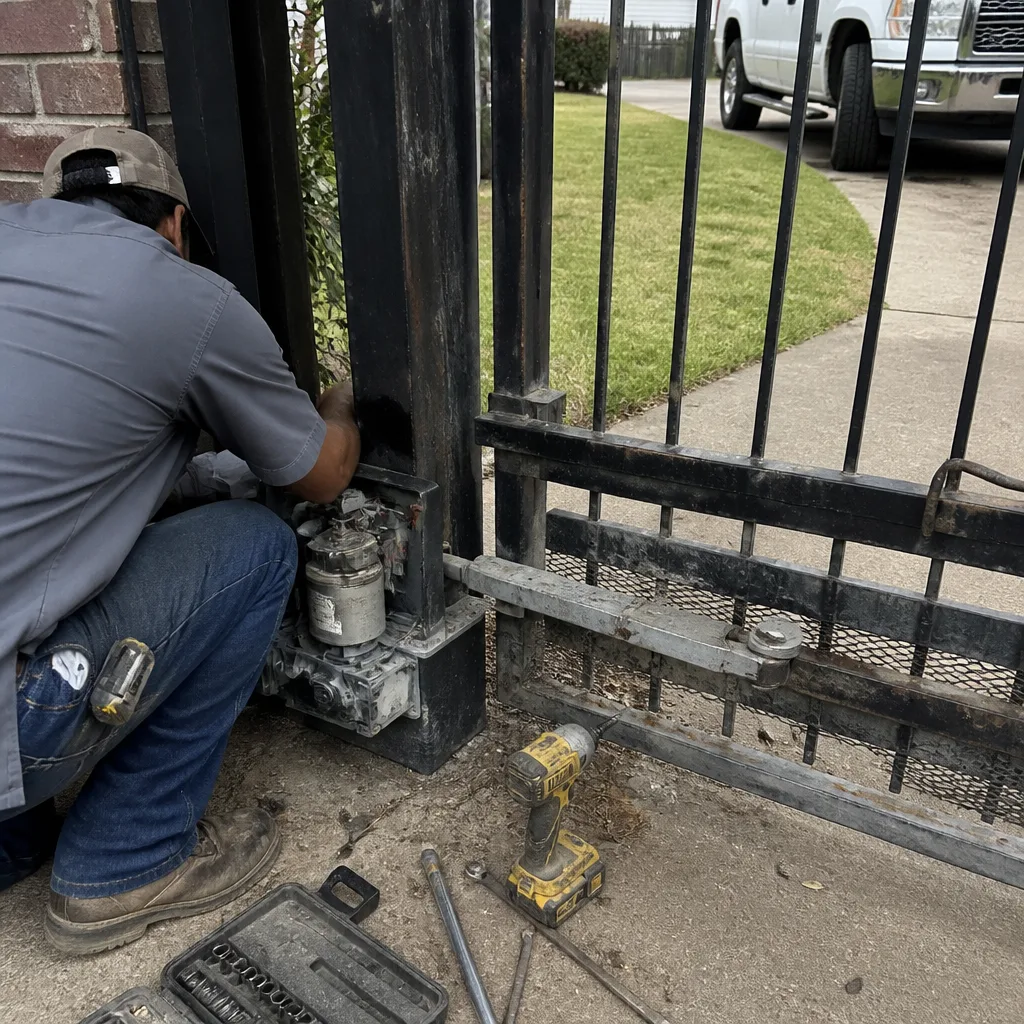 Before
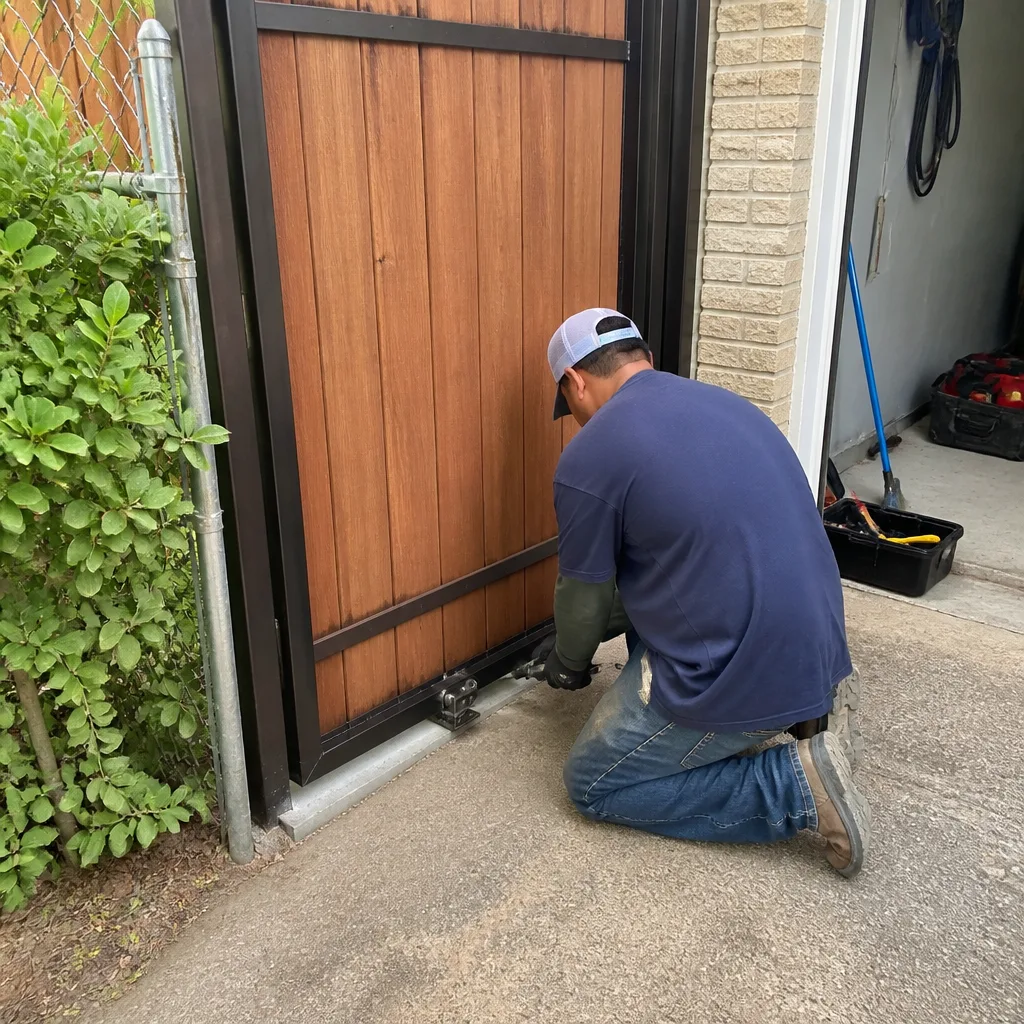 After
AfterGate Repair Maintenance Checklist for Baytown Homeowners
Salt-air corrosion in Baytown doesn’t wait for winter. We’ve measured hinge bolts in neighborhoods closest to the Ship Channel showing surface rust in as little as 90 days without a specific protective treatment sequence. A generic gate maintenance checklist you’d download from a national hardware site wasn’t written for a city where the humidity averages 75% year-round and the wind carries chloride particles from Galveston Bay onto your gate hardware every single day. This guide replaces the generic with the measurable: what to check, how often, what to record, and which products actually hold up in this environment. For more guides & resources, see our blog.
Quick Answer
A Baytown gate maintenance checklist that actually works runs on three cycles: a 30-day visual and function check (rust, hinge play, photo-eye alignment, operator torque), a 90-day mechanical check (bolt torque, amp draw, limit-switch drift), and an annual deep service (conduit inspection, capacitor health, full hinge disassembly and re-lube). Every inspection should log specific measurements, not just “looks fine,” so drift is caught before a $900 motor replacement becomes the conversation.
Table of Contents
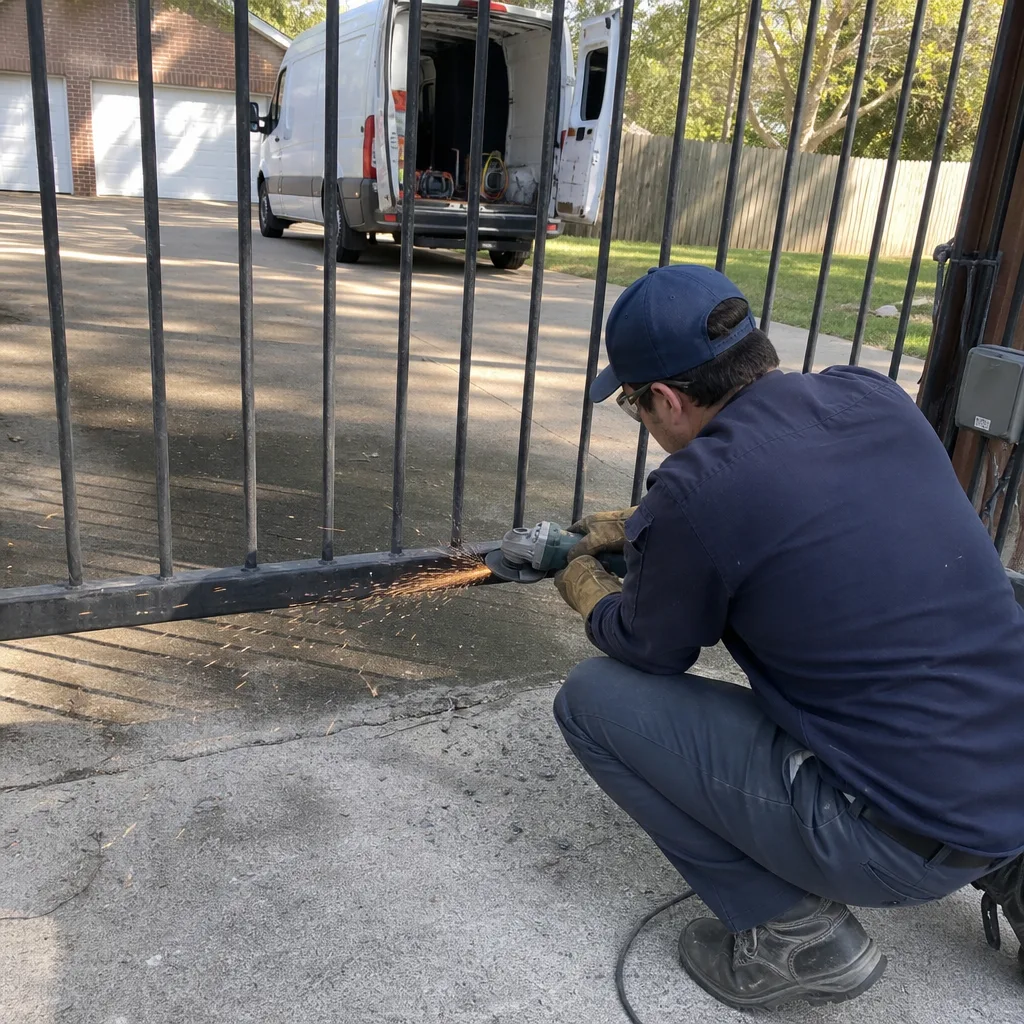
- Why Baytown Corrodes Gate Hardware Faster Than Inland Texas
- The Three Inspection Cycles: 30-Day, 90-Day, Annual
- Measurements to Log Every Time: Limit Switches, Amp Draw, Hinge Torque
- Documentation Protocol: Building a Baseline You Can Compare Against
- Products That Hold Up in Baytown Humidity vs. ‘Weatherproof’ Marketing Claims
- Turning a Completed Checklist into a 12-Month Repair Cost Prediction
- Common Mistakes to Avoid
- When to Call a Professional
- Frequently Asked Questions
BeforeAfterWhy Baytown Corrodes Gate Hardware Faster Than Inland Texas
Baytown sits roughly 25 miles from Galveston Bay, and the industrial corridor along the Houston Ship Channel adds a layer most coastal communities don’t face. The air here carries two corrosion agents: natural marine chloride from the bay, and sulfur compounds from refinery and petrochemical operations. Together they form a mild acid film on exposed metal, and when that metal is already hot from a Texas sun, the reaction accelerates. Hinge bolts, chain links, limit-switch housings, and control board terminals all take the hit.
What we see in our Gate Repair services across Baytown is a pattern: the gate operator’s internal components stay relatively clean because they’re inside a sealed housing, but everything exposed to open air degrades three to four times faster than the same parts would in Conroe or The Woodlands. A zinc-plated hinge bolt that lasts five years inland shows surface rust in 6 to 12 months here. Chain-drive operators pick up a gritty, salt-laden film that acts like sandpaper on the sprocket teeth. Capacitors, which hate heat and humidity, drift out of spec faster than their rated lifespan would suggest.
The practical takeaway for a Baytown homeowner: inspection frequency matters more than inspection thoroughness at any single visit. A monthly visual pass that catches rust before it reaches the bearing surface will save more money than an annual teardown that finds the rust after it’s already eaten the thread.
The Three Inspection Cycles: 30-Day, 90-Day, Annual
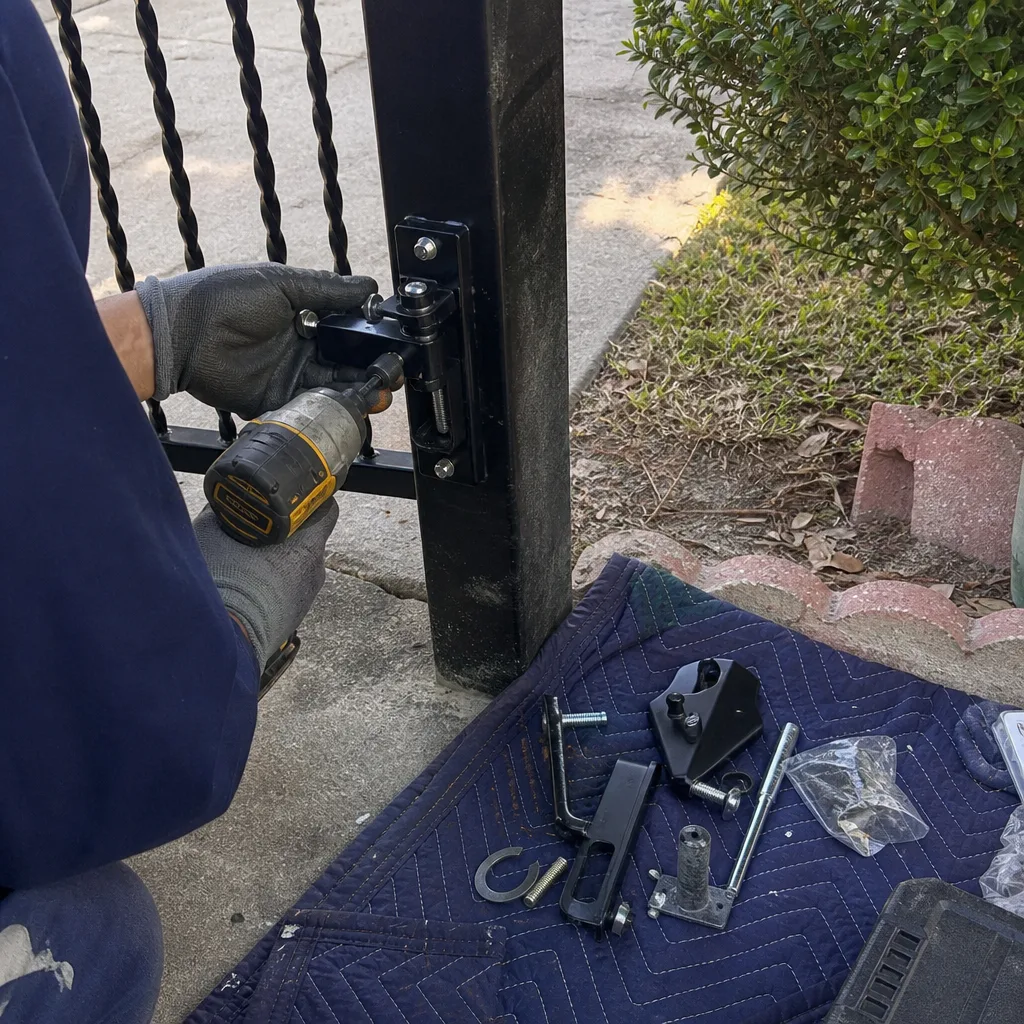
The 30-Day Visual and Function Check (15-20 minutes)
This is the cycle most homeowners skip and the one that prevents most surprise failures. It doesn’t require tools beyond a flashlight, a pair of gloves, and your phone camera. Baytown’s humidity means deterioration shows itself quickly if you know where to look.
- Run the gate through a full open-close cycle. Listen for changes: a new grinding sound, a pause that wasn’t there before, a hesitation reversing direction. A gate that used to run smooth and now sounds like it’s working harder is telling you something specific, usually a hinge binding or motor strain.
- Check hinge bolts for rust bloom. Look at the thread end of each bolt, the nut, and the hinge barrel itself. In Baytown ZIP codes east of Highway 146, we typically see first rust at the 90-day mark on untreated hardware. A surface-orange dusting means clean and treat now; a deep red-brown means the bolt is actively losing material and should be replaced at the next 90-day cycle.
- Inspect the photo-eye pair. The photo-eye is the infrared beam that stops the gate if something crosses the path. In Baytown’s humidity, the lens gets a condensation film and the mounting bracket shifts when the post expands and contracts with temperature swings. Clean both lenses with a dry cloth, check the bracket screws are snug, and verify the gate reverses when you break the beam with your hand.
- Check the chain or belt tension. A chain that droops more than 1/2 inch at mid-span or a belt that slips on the drive pulley needs adjustment. Both degrade predictably in a salt-air environment: chain links stretch and surface-rust, belts dry and glaze in the heat.
- Clear the track or guide path. Leaves, dirt, and the fine silt that blows off the Ship Channel corridor accumulate in the track. Ten minutes with a brush and a shop vac once a month saves a roller replacement every year.
The 90-Day Mechanical Check (30-45 minutes)
Every 90 days, the checklist shifts from visual to physical. You’ll need a socket set, a torque wrench if you have one, a clamp meter (a $25 tool that’s worth its weight in avoided motor replacements), and the same documentation habit from the 30-day cycle.
- Torque-check every hinge bolt and mounting fastener. The expansion and contraction cycle of Baytown’s hot days and relatively cool nights works bolts loose over time. Write down the torque value you set each bolt to, so the next check reveals if it’s backing out. If a bolt keeps loosening, it’s not a maintenance issue – it’s a sign the hinge bore is wallowed out or the post is moving.
- Measure the operator’s amp draw at full load. This is a number, not an observation. A LiftMaster LA400 on a single swing gate in Baytown typically draws between 2.5 and 4.5 amps at full load. If you log 3.2 amps in March and 4.8 amps in June, something is binding – a hinge, a roller, a chain link. The motor isn’t “getting old”; it’s working against mechanical resistance that should be corrected before the winding insulation fails.
- Check and record limit-switch positions. The limit switch tells the motor where to stop at full open and full close. Drift of even 10 degrees is a signal that something is wearing: a gear, a screw-drive assembly, a chain link stretching past spec. Record the open and close positions so you can see the drift in the next check. If the gate now travels 15 degrees farther than it did 90 days ago, that’s data, not a guess.
- Inspect the control board visually. Look for dust accumulation, moisture film, and any discoloration around relays. Baytown’s humidity level means boards that aren’t protected by a conformal coating build a resistive film that causes ghost-triggering. A board that’s clean except for a white hazy deposit needs contact cleaner and possibly a housing gasket replacement.
- Lubricate using environment-appropriate products. More on this in the products section below, but the rule is: no WD-40 on a gate hinge in Baytown, ever. It strips the protective film and leaves bare metal exposed to salt air.
The Annual Deep Service (2-4 hours)
The annual cycle is when you do the full inspection that catches what the shorter cycles can’t see. It’s also the cycle where most Baytown homeowners should consider calling a gate company for the documentation alone – more on that in the documentation section. Before scheduling, review Gate Repair Permits, Codes & Inspections in TX: What You Need to Know.
- Inspect all conduit and wiring entry points. UV and heat degrade the PVC jacket on low-voltage wire. A cracked conduit elbow lets water follow the wire into the operator housing, and in Baytown, that water is carrying salt. Pinched wires where the gate articulates are the single most common point of failure we see on swing gates.
- Disassemble hinges fully. Pull the pins, inspect the bearing surfaces for pitting and wear, clean everything, and apply a marine-grade grease. This is the one annual step that’s genuinely difficult for a DIYer because it means supporting the gate while the hinges are apart, and a 12-foot steel gate is heavier than it looks – 300 to 600 pounds is typical without the opener attached.
- Test the capacitor bank in the operator. Capacitors degrade with heat, and a Baytown summer in an unventilated metal housing cooks them steadily. A capacitor that’s 20% out of spec still runs the motor, but the motor runs hot, draws more current, and shortens its own lifespan. Replacement is a $30 part versus a $600 motor.
- Verify the ground connection resistance. Salt-air environments accelerate ground corrosion, and a high-resistance ground causes intermittent behavior that looks like a haunted gate – opening on its own, stopping mid-travel, not responding to a remote. A clean, tight, low-resistance ground is a value-builder for the whole system.
Measurements to Log Every Time: Limit Switches, Amp Draw, Hinge Torque
A checklist that says “check hinge” is worthless. A checklist that says “hinge bolt #2 set at 35 ft-lbs, was 34 ft-lbs last check, no movement” is a maintenance document. The difference is measurement.
What to record on a swing gate
- Hinge bolt torque: Log each bolt individually. Bolt #1, #2, #3, #4. Note the torque value and whether it moved from the previous reading. On a typical Baytown residential swing gate with 1/2-inch or 5/8-inch hardware, expect to set between 30 and 45 ft-lbs depending on the hinge design. Record from the manufacturer’s spec for your hinge.
- Limit-switch open position: In degrees from closed. If your gate opens to 92 degrees and the limit is set to cut power at 92, record “limit open: 92°.” Next check, if the gate travels to 98 before stopping, you have 6 degrees of drift to investigate.
- Limit-switch close position: Same measurement at the closed end. On a gate with an automatic latch, the close limit is critical: drift past full close means the latch doesn’t engage, and that’s what turns a “closed” gate into an open one at 2 a.m.
- Amp draw at full load: Measured at the motor terminals with a clamp meter while the gate is moving under its normal load. Ten seconds of data. One number written down.
- Amp draw at start: The inrush current when the motor starts. It’s always higher than full-load, but if it spikes dramatically from one check to the next, you’re catching a bearing starting to seize or a gear wearing, weeks before it becomes obvious.
What to record on a slide gate
- Roller gap at top and bottom track: Measure with a feeler gauge. A slide gate that’s running 1/8-inch clearance on top and 3/16-inch on bottom is normal. When that gap changes, the post has shifted or the rollers are wearing.
- Chain sag at mid-span: With the gate at mid-travel, measure the vertical droop in the chain. More than 1/2 inch is adjustment territory. Record the number so you know if it’s worsening between checks.
- Drive sprocket tooth wear: Visually check for shark-finning, the asymmetric wear pattern where the leading edge of each tooth thins and curves. In Baytown’s gritty environment, driven sprockets wear faster on the load side. Record any tooth that’s lost more than 25% of its face width.
Why measurements are the only thing that catches slow drift
Most gate failures in Baytown aren’t sudden. A hinge wears out over 18 months. A capacitor drifts out of spec over a summer. A limit switch slips 2 degrees per month for six months until the gate is pushing past its stop point and bending the arm bracket. The human eye and hand can’t feel a 2-degree monthly drift or a 0.3-amp quarterly rise. But a written log shows it immediately. That log is the difference between a $40 hinge replacement in month six and a $1,100 motor and arm bracket replacement in month twelve.
Documentation Protocol: Building a Baseline You Can Compare Against
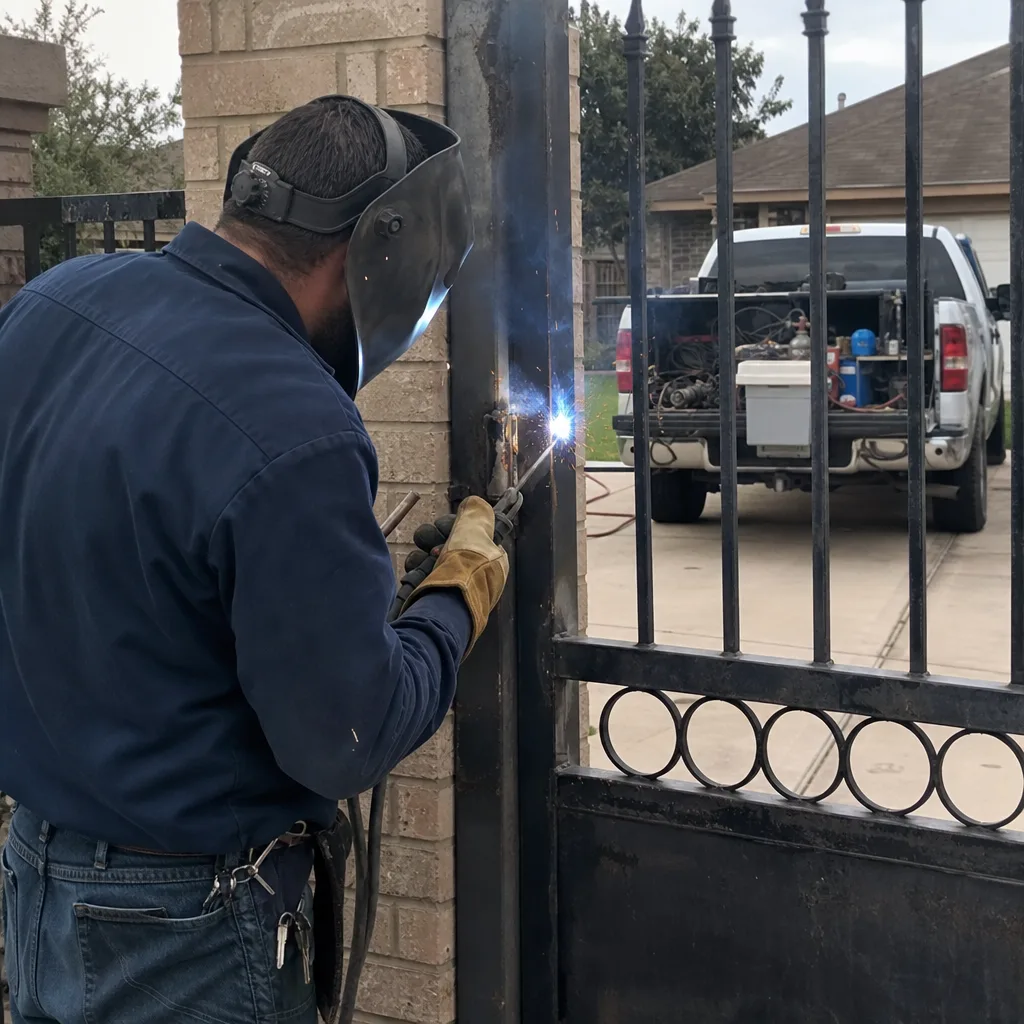
Every measurement you take is only useful if it’s compared to something. The first time you service a gate, you’re building the baseline. Every check after that is a comparison to the baseline. Without the baseline, you’re guessing. With it, you’re managing.
What a workable baseline log contains
- The date and time of the inspection
- Ambient temperature (matters more than people think: metal expands measurably between 50°F and 95°F)
- Every measurement listed above, in the same position so numbers line up row against row
- A photo of the operator board, hinges, and chain at each inspection
- Notes on anything lubricated, adjusted, or replaced
- The product name and part number of any replacement component
The photo habit that saves hundreds of dollars
Photography is the cheapest documentation tool you own. Before you touch anything, photograph the operator housing with the cover off, each hinge at eye level, the chain or belt at mid-span, and the limit-switch assembly. After you’re done, photograph the same four positions again. You now have a dated visual record that shows what changed, what you set, and what was already corroding. Next quarter, you compare the photos side by side.
This is not a nice-to-have. In our gate repair and gate installation work in Baytown, the documented photo habit saves homeowners a measurable amount of money because it turns “it’s been making this noise for a while” into “here’s what it looked like June 3rd, August 22nd, and November 15th, and here’s how fast the rust progressed.” Under The Haven Standard, every visit from Vance Gate Repair Baytown includes a photographed record of what was found, what was adjusted, and what was replaced, handed to the homeowner and filed in the job record. Our 365-Day Done Right Promise means that if anything in that documented repair fails within a year, the repair is made right at no charge. That’s the model we recommend homeowners apply to their own maintenance log. For more on how this works, see our Baytown gate repair service page.
Products That Hold Up in Baytown Humidity vs. ‘Weatherproof’ Marketing Claims
Baytown is a specific environment, and the products that hold up here are specific. The “weatherproof” label is a marketing term; it doesn’t tell you whether a housing gasket survives three summers of Houston heat, salt film, and UV exposure. Here’s what we’ve learned from 22,000+ gate repairs and installations since 2014.
Lubricants: what to use
- Hinges and bearing points: Marine-grade lithium complex grease, not spray lithium. Spray lithium doesn’t stay in place on a hinge barrel in Baytown’s heat, and it doesn’t build the film thickness a swing hinge needs. Look for a lithium complex with an ISO 220 or higher base oil.
- Chain drive: A motorcycle chain lube that dries semi-tacky. Wet lubes pick up the airborne grit from the Ship Channel corridor and turn into grinding paste. Dry lubes dissolve in humidity. Semi-tacky is the sweet spot for this environment.
- Belt drive: No lube. A belt is a wear item. Lubricating it breaks down the compound and accelerates cracking.
Materials: what to specify
- Hinge bolts: 316 stainless steel or hot-dip galvanized. Zinc-plated hardware in Baytown is a temporary installation. 316 stainless carries a premium but it’s the difference between a hinge you clean and a hinge you replace. Don’t mix stainless bolts into a mild-steel hinge body without a sacrificial washer, or you’ll trade bolt rust for galvanic corrosion on the hinge itself.
- Control board protection: Look for a board with a conformal coating, which is a thin protective film applied over the PCB. Most industrial-spec operators have it; many residential units don’t. If the board in your existing operator shows a white haze, it doesn’t have adequate protection for Baytown’s environment and should be cleaned and possibly re-coated or sealed.
- Cable and conduit: Soow-rated cord or marine-grade jacketed cable for any exposed, flexing section. PVC conduit fittings should be glued and sealed at every joint – the water that gets in at a slip-fit fitting follows the wire into the housing.
Operator brands and Baytown-specific notes
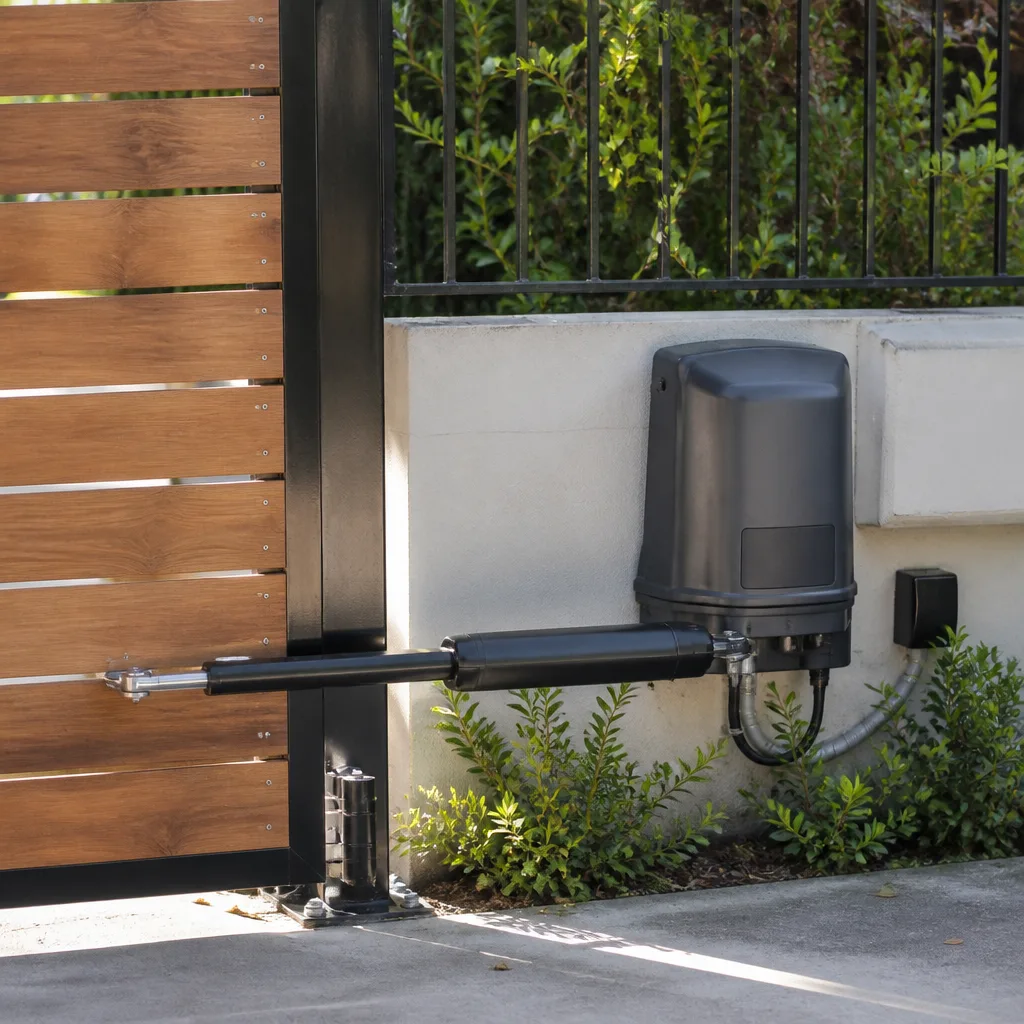
We service nine major gate-automation brands including LiftMaster, FAAC, BFT, and Linear. Each has specific characteristics in this climate. LiftMaster residential operators are common on Baytown homes and the LA400 and SL300 are workhorses, but their plastic limit cams wear faster in the heat and need more frequent adjustment than the spec sheet implies. FAAC operators, more common on higher-end Baytown properties, use an oil-bath hydraulic design that’s better sealed against humidity but needs oil level and condition checks on an annual cycle. BFT units generally hold limit settings well but their photo-eye brackets are prone to shifting with the thermal cycling of steel posts. Linear operators have relatively simple limit systems that are easy to set and document, which matters if you’re managing your own maintenance. For Baytown homeowners with one of these units, see our gate motor and opener service page, which covers all nine brands we service.
Products marketed as weatherproof that degrade in 6 months here
- Spray silicone on visible hardware: It looks protected; it’s not. Silicone film doesn’t block chloride penetration, and it disappears fast in heat. Within six months, rust has started under it.
- Vinyl-coated gate hardware: The coating holds water against the metal at any pinhole, and a pinhole is guaranteed within months in this environment. Vinyl coating on a Baytown gate is a rust accelerator disguised as a product.
- Standard zip ties for cable management: They degrade, crack, and fall off in under a year in this UV exposure. Stainless cable ties or UV-rated nylon are the only ones that last.
- Powder-coated steel posts without drainage weep holes: Water gets in at the post cap and sits in the bottom. The post rusts from the inside out, and the first sign is usually the gate sagging because the post rusted through at ground level.
Turning a Completed Checklist into a 12-Month Repair Cost Prediction
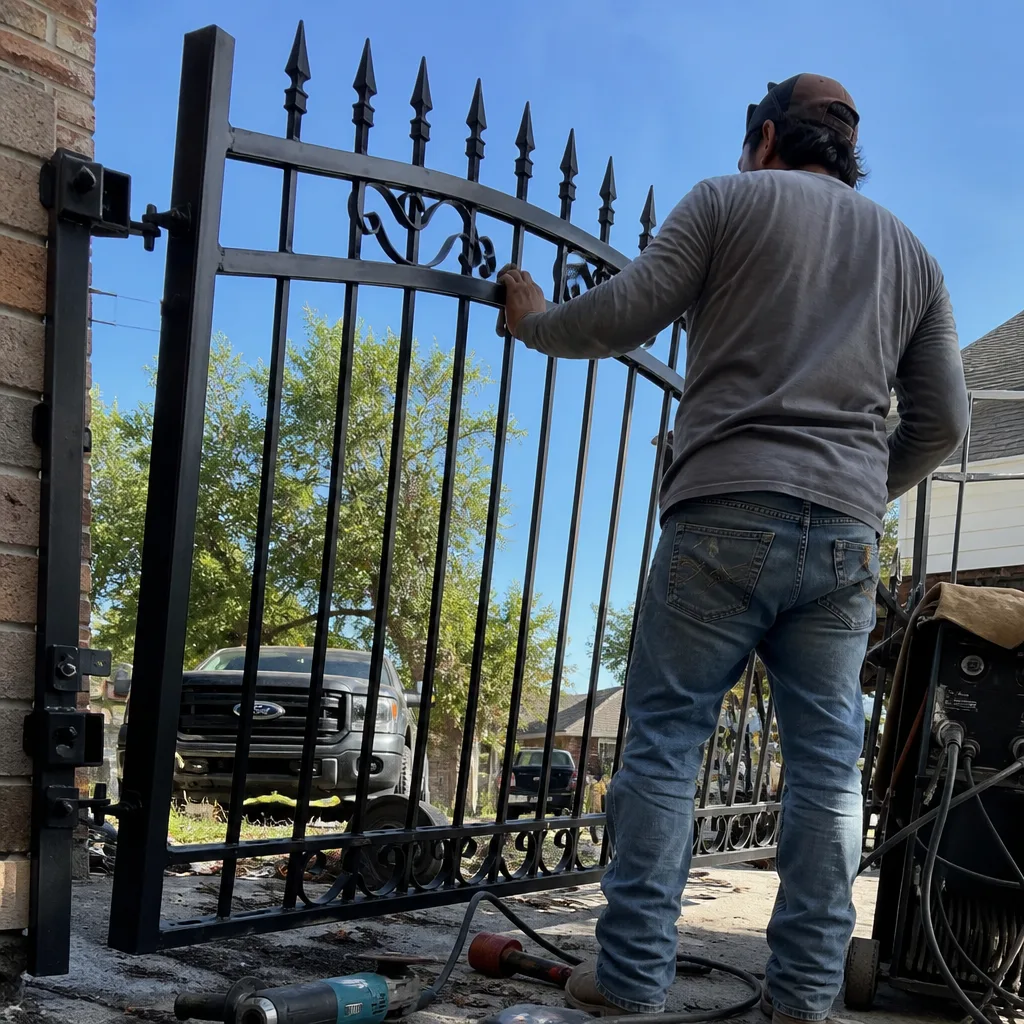
The maintenance log is a financial planning tool. When you’ve tracked amp draw, limit drift, hinge torque, and rust progression for two or three cycles, you can read the trend line. That trend line is a repair cost prediction, and it’s far more accurate than any estimate based on age alone.
Reading the trends
- Rising amp draw at full load: If draw climbs 10% over two consecutive 90-day checks, budget for a hinge replacement in the next 12 months. In Baytown, this typically runs $180 to $390 per hinge including parts, labor, and on-site welding if required, depending on gate weight and access.
- Limit-switch drift beyond 8 degrees: Budget for limit assembly replacement or gear service in the next 6 to 12 months. Typical cost range in Baytown: $120 to $240.
- Chain stretch beyond adjustment range: Replace the chain before it eats the sprocket. You can stretch a chain adjustment twice, maybe three times. After that, a new chain on a worn sprocket wears out in half the time. Chain and sprocket replacement pair in the range of $250 to $450 for a typical residential slide gate in Baytown.
- Capacitor out of spec: Replace immediately. $30 to $60. Waiting means the motor runs hot, and the eventual motor replacement runs $600 to $1,400 depending on operator brand and model.
- Rust blooms on hinge bolt threads: Clean and treat now, replace at next 90-day cycle. Hinge bolt replacement is typically $60 to $120 per hinge when caught early, per-bolt. When caught late, the hinge body is usually pitted too, and that’s a full hinge replacement with welding – starting around $350 per hinge and going up from there.
All of these ranges assume the parts are being replaced before the failure cascades. That’s the entire value of the maintenance log: you’re scheduling a $40 part replacement instead of discovering a $1,100 failure. Under The Haven Standard, every job from Vance Gate Repair Baytown starts with a written price, handed to the homeowner before any tool is picked up, and completed with a documented photo log. That means a repair estimate is specific to your gate, your measurements, and your observed trends – not a price range printed on a brochure.
Common Mistakes to Avoid
- Lubricating a rusty hinge instead of treating the rust first. Grease over rust is rust locked in. The correct sequence for Baytown is: remove surface rust, treat with a rust converter, allow it to cure, then apply marine-grade grease as the protective film. Skipping steps one and two means the hinge keeps corroding under the grease.
- Using WD-40 as a gate lubricant. WD-40 is a water displacement product, not a gate lubricant. On a Baytown gate, it strips whatever protective film was there, leaves a thin residue that evaporates in days, and exposes the bare metal to salt air. It’s actively worse than doing nothing.
- Ignoring the gate when it “still works.” A gate that runs despite rising amp draw and limit drift is a gate consuming its own components. The bill doesn’t arrive with the symptom; it arrives when the symptom becomes a failure.
- Adjusting the limit switch repeatedly without recording the values. Every adjustment without a recorded value is a fresh guess. You can’t see drift if you keep resetting the baseline every time.
- Assuming a sealed operator housing is airtight. In Baytown’s climate, temperature cycles push and pull air through every gap. Conformal coating is the line of defense; the housing is just the outer wall.
- Replacing one hinge when the others show the same wear. Gates don’t fail on fatigue alone; they fail on asymmetric wear. A new hinge next to two worn hinges just moves the stress point. Replace all hinge sets on the same service cycle.
- Deferring the annual inspection because the gate “passed” the 30-day check. The 30-day check catches fast-developing problems. It cannot see a capacitor drifting out of spec, a ground connection corroding inside the housing, or a hinge bore wallowing out below the visible surface.
When to Call a Professional
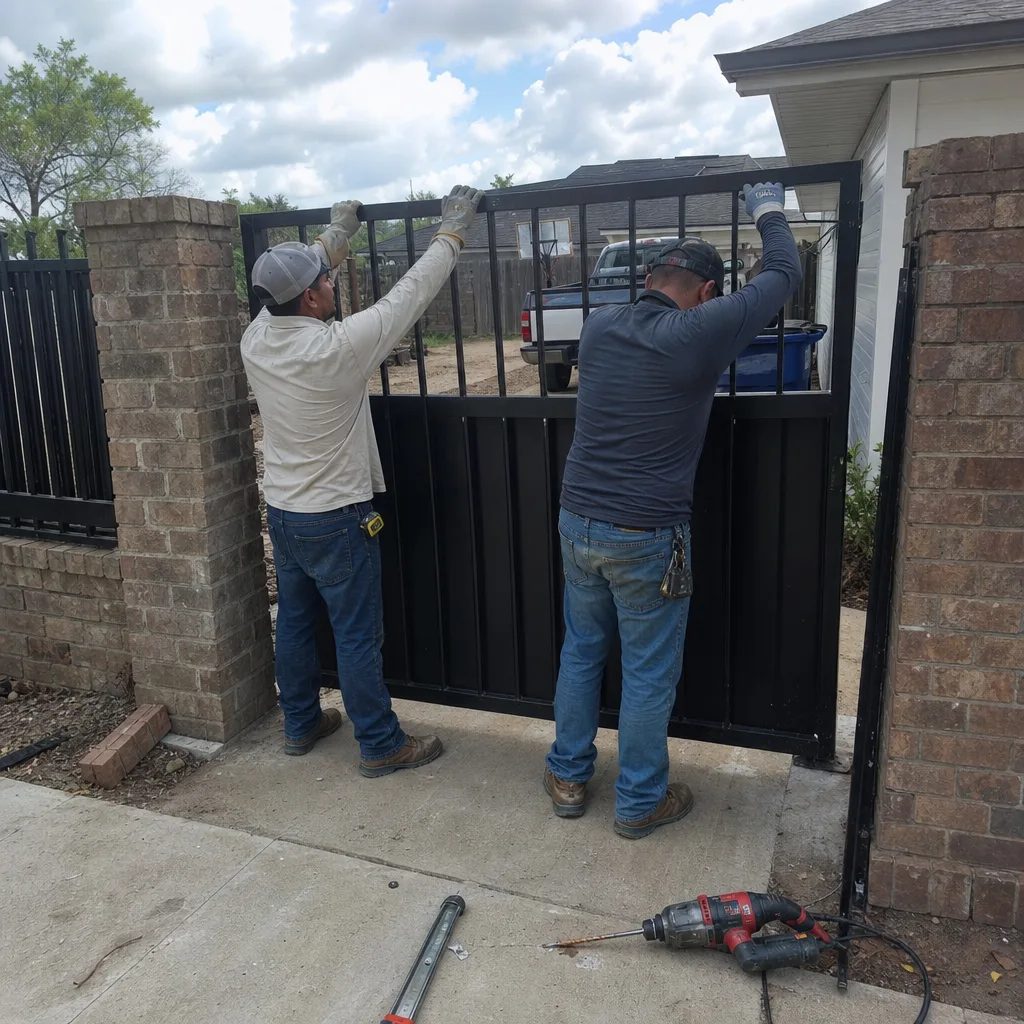
The DIY maintenance checklist covers inspection, measurement, lubrication, and minor adjustment. It does not cover several jobs that carry real risk or require specialized equipment. If you find the gate drifting well past its limit position, if the amp draw has climbed more than 25% since your baseline, if a post has visible rust at ground level, or if the gate has ever reversed while opening or failed to stop at a limit, call someone who does this work daily. Welding on a gate hinge while the gate is under spring tension or supporting 400 pounds of cantilevered steel is not a maintenance task. We’ve also seen homeowners attempt to open a hydraulic operator to check the oil level and lose the system’s seal in the process. A gate operator line is also an electrical line; it’s not line voltage for a residential unit, but the capacitor holds a charge that deserves respect.
Vance Gate Repair Baytown offers free estimates across Baytown. Call (346) 315-4812 and a live person answers – no voicemail tree to navigate, no 48-hour callback window. We’ll schedule a visit, take measurements, and hand you a written price before any work starts.
Frequently Asked Questions
Monthly. The chloride and sulfur content in the air within a few miles of the Ship Channel accelerates corrosion measurably compared to inland parts of Baytown. A 30-day visual check that catches surface rust early will save you a hinge or bolt replacement at the 90-day mark.
Expect $120 to $280 for a professional 90-day inspection and lubrication service on a typical residential swing or slide gate in Baytown, depending on size and operator type. An annual deep service with full documentation typically runs $250 to $500, and the value is in the documented baseline it creates.
Yes, in most cases for a standard repair. Vance Gate Repair Baytown offers same-day service for gate repair, and a live person answers the phone 24/7 at (346) 315-4812 to schedule it. The exception is when a part must be ordered, but nine out of ten common Baytown gate failures can be addressed the same day because we carry stock for LitMaster, FAAC, BFT, Linear, and the other majors.
Check the obvious first: the breaker, the photo-eye alignment, and the battery in the remote. If all are fine, the heat and humidity have likely affected the control board or the capacitor. Call (346) 315-4812 and we’ll test it rather than guessing. Replacing a remote-controlled operator’s board without measuring amp draw and capacitor condition is a very expensive way to avoid a $40 fix.
It’s necessary if you care about catching drift before failure. The log is what separates a gate you manage from a gate you react to. A well-kept log reduces the average repair bill in Baytown because it catches bearing, capacitor, and hinge problems while they’re single-component fixes, not system failures.
Hinge corrosion and bearing wear on swing gates lead the list, followed by photo-eye misalignment, seized chain links, and capacitor failure from heat exposure. See Gate Repair Warning Signs: A Baytown Homeowner’s Reference Guide for the full breakdown. Slide gates show more roller and track wear, plus chain stretch where the drive chain flexes at the wheel. Every one of these produces a measurable signature before it produces a breakdown.
The Bottom Line
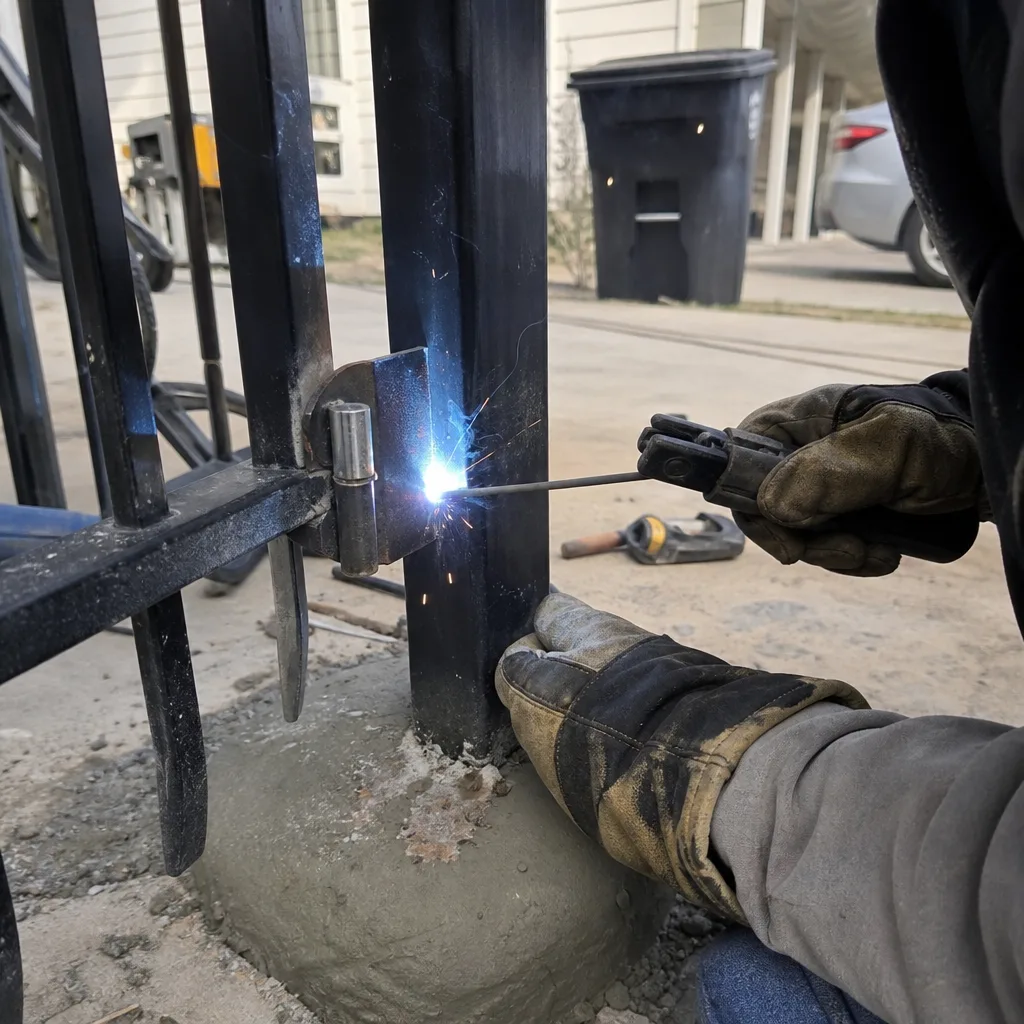
A maintenance checklist for a Baytown gate works only if it’s built for this air, this heat, and this salt. Run the 30-day visual check without fail, log the measurements at 90 days so drift has a number instead of a feeling, and do the annual deep service with the goal of replacing the cheap part before the expensive one. Document everything with photos and numbers. The homeowner who writes down 4.2 amps in March and 4.8 amps in June catches a binding hinge before it breaks. The homeowner who only listens for noise catches the bill after the motor quits. If any of this process gets beyond what you’re comfortable doing, call (346) 315-4812 for a free, written price – and a documented record of whatever we find.
Written by Adrian Vance, Owner at Vance Gate Repair Baytown, serving Baytown since 2014.